
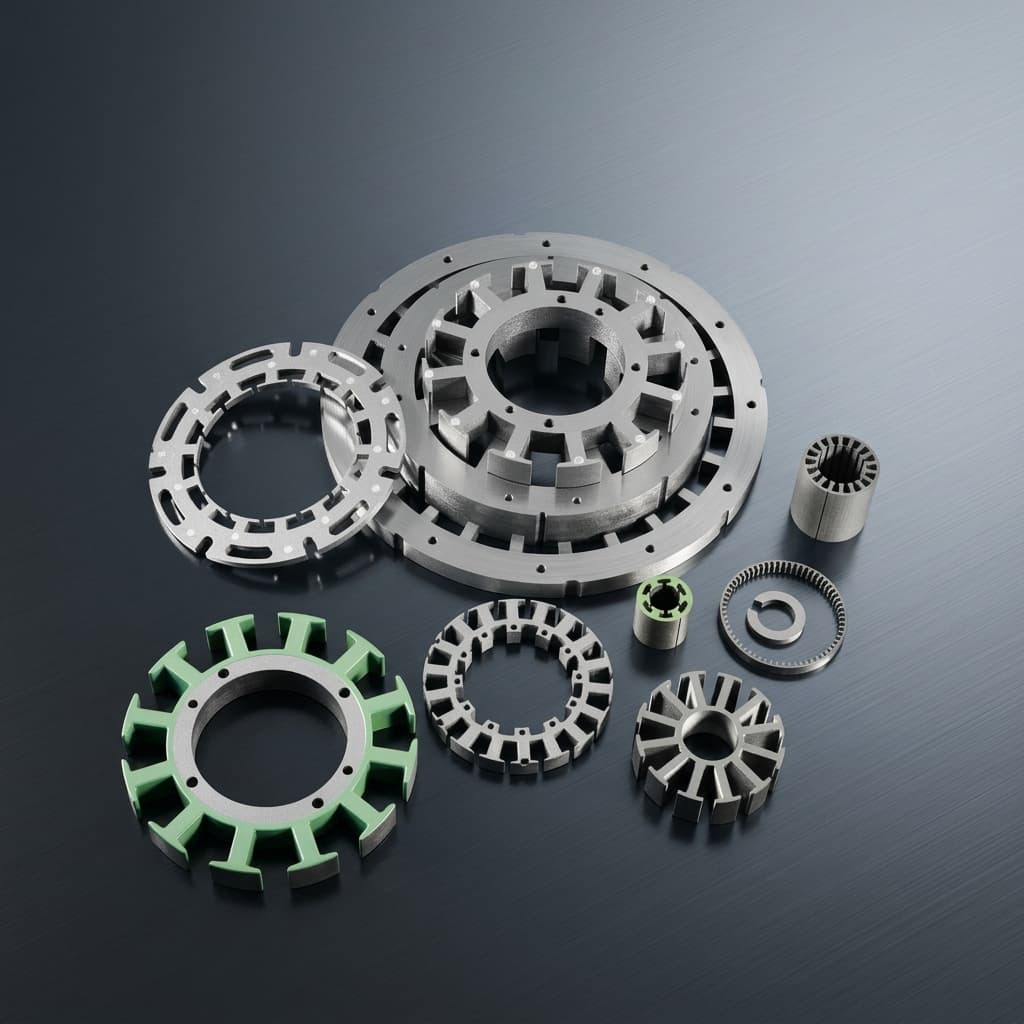
Axial Flux Motor Topologies (YASA, AFIR, TORUS): A Core Sourcing & Procurement Guide
Compare YASA, AFIR, and TORUS axial flux motor topologies for stator core sourcing, SMC vs laminated steel choices, RFQ risk control, and DFM review.
Executive Summary
- The Core Sourcing Challenge: Selecting an Axial Flux Permanent Magnet (AFPM) motor topology is not just an engineering decision; it fundamentally locks your procurement team into specific stator core materials, manufacturing processes, and supply chain constraints.
- YASA (Yokeless and Segmented Armature): Offers extreme torque density and lightweight performance, but necessitates Soft Magnetic Composites (SMC) or highly complex segmented laminations. This narrows the supplier base to specialized powder metallurgy firms.
- AFIR (Axial Flux Internal Rotor): Provides robust, symmetrical performance. Its dual-stator configuration is highly compatible with both advanced SMC and traditional rolled/slotted laminated steel, offering greater supply chain flexibility and lower tooling risks.
- The Material Crossroads: The choice between YASA, AFIR, and TORUS topologies directly dictates whether you will be sourcing massive volumes of silicon steel laminations or investing in advanced SMC compaction tooling. Understanding this relationship is critical for controlling Total Landed Cost (TLC) at scale.
The transition from traditional radial flux machines to Axial Flux Motors (AFMs) introduces significant paradigm shifts in how electric motors are designed, manufactured, and sourced. For OEMs in the automotive, aerospace (eVTOL), and industrial robotics sectors, the axial flux architecture offers unmatched power density and a compact "pancake" form factor. However, beneath the surface of these high-level benefits lies a complex matrix of topological choices.
The three primary axial flux topologies—YASA, AFIR, and TORUS—each present unique magnetic flux paths. More importantly for supply chain leaders and product managers, these topologies dictate the manufacturability of the motor's most critical stationary component: the stator core.
This comprehensive guide is designed for procurement teams, motor design engineers, and supply chain strategists. We will deconstruct how each major AFPM topology influences stator core material selection (Laminated Steel vs. SMC), highlight the procurement risks associated with each, and provide a framework for making highly informed sourcing decisions in 2026 and beyond. For a deeper material trade-off view, pair this topology guide with the SMC vs. laminated axial flux core sourcing guide.
Scope note (updated July 24, 2026): This guide applies to early topology-to-core-material decisions for global OEM programs. It does not replace electromagnetic finite-element analysis, thermal validation, winding automation trials, or supplier PPAP; final material selection should be validated against duty cycle, target frequency, cooling method, packaging envelope, and annual volume.
RFQ checkpoint: If you already have a topology candidate, send the topology, target frequency, annual volume, and packaging envelope to Axialfluxcore for a DFM and Total Landed Cost review before tooling is frozen.
1. Introduction: How Topology Dictates the Supply Chain
In traditional radial flux motors, the supply chain for stator cores is incredibly mature, relying on thousands of global suppliers capable of high-speed progressive die stamping of 2D silicon steel sheets. The axial flux motor disrupts this ecosystem. Because the magnetic flux travels parallel to the rotational axis and often requires three-dimensional pathways, standard flat laminations become highly inefficient or impossible to use without introducing severe eddy current losses.
When engineering teams select a specific axial flux topology, they are simultaneously making a supply chain decision. The topology determines whether the stator core must be segmented, whether it requires a yoke to return the magnetic flux, and whether the magnetic field travels in a purely 2D plane or requires 3D isotropic materials.
If engineering selects a topology that mandates highly complex 3D flux paths, procurement must source Soft Magnetic Composites (SMC). If engineering selects a topology with straightforward 2D planar flux, procurement can leverage more traditional, widely available laminated steel coil suppliers. The friction between engineering performance goals and procurement cost/risk constraints is where most AFPM projects succeed or fail.
2. Deep Dive: YASA (Yokeless and Segmented Armature)
First popularized by academic research (notably Woolmer and McCulloch in 2007) and later commercialized extensively in the hypercar and aerospace sectors, the Yokeless and Segmented Armature (YASA) topology represents the bleeding edge of power density.
Engineering Principles of YASA
The YASA topology typically consists of a single stator sandwiched between two rotors (often referred to as an axial flux internal stator configuration, but specifically optimized by removing the stator yoke). The magnetic flux travels directly through the stator teeth from one rotor to the other. Because the flux does not need to turn 90 degrees and travel circumferentially through a back-iron (yoke), the yoke can be entirely eliminated. Furthermore, the stator is broken down into individual, disconnected segments (teeth). Each tooth is individually wound with copper wire before being assembled into a ring.
Core Material Procurement: The Dominance of SMC
For procurement teams, the YASA topology almost exclusively dictates the use of Soft Magnetic Composites (SMC) for the stator teeth.
- Why SMC is Required: The segmented nature of the YASA stator means each tooth is an independent 3D block. Attempting to build these individual, complex geometric blocks out of stacked laminations is incredibly wasteful, structurally weak, and prone to high high-frequency losses. SMC, manufactured via net-shape powder compaction, allows these individual teeth to be pressed quickly, consistently, and with zero material waste.
- Sourcing Dynamics: Sourcing SMC for YASA motors requires finding suppliers with high-tonnage powder metallurgy presses and tight control over binder curing atmospheres. The supplier base is smaller than that of traditional steel stampers, requiring deeper vetting and earlier engagement in the NPI (New Product Introduction) phase. Prototype teams should also align compaction geometry, winding clearance, and inspection gates early; the SMC stator prototyping DFM guide covers those handoffs in more detail.
Supply Chain Bottlenecks
- Tooling Costs: While SMC compaction tools are cheaper than progressive stamping dies, the segmented nature means you need multi-cavity tooling to reach high volumes.
- Assembly Complexity: Procurement isn't just buying a core; they are buying a complex assembly problem. The individual SMC teeth must be precision-aligned, potted, and mechanically secured without a structural yoke to hold them together, pushing the burden onto structural adhesives and overmolding suppliers.
3. Deep Dive: AFIR (Axial Flux Internal Rotor)
The Axial Flux Internal Rotor (AFIR) topology is the workhorse of industrial and commercial AFPM applications. It features a single rotor sandwiched between two external stators.
Engineering Principles of AFIR
In the AFIR topology, the magnetic flux travels from the first stator, across the air gap, through the internal rotor, across the second air gap, and into the second stator. The flux then travels circumferentially through the stator yoke (back-iron) to complete the circuit. This topology provides a highly symmetrical magnetic circuit, which helps balance axial magnetic forces and simplifies bearing design.
Core Material Procurement: Flexibility is Key
The AFIR topology offers the greatest flexibility for procurement, as both traditional Laminated Steel and SMC are viable options, depending on the operational frequency and budget.
- Laminated Steel Approach: Because the stators are continuous rings with yokes, they can be manufactured using edge-winding or mandrel-coiling techniques. A continuous strip of electrical steel is wound into a cylinder, and slots are either pre-stamped or machined post-winding. This allows procurement to leverage traditional steel service centers and motor core winders.
- SMC Approach: Alternatively, the entire AFIR stator can be pressed from SMC, especially if the motor operates at high frequencies (>400Hz) where laminated steel suffers from excessive eddy current losses. Use measured loss curves rather than catalog assumptions; see the high-frequency AFPM magnetic loss testing guide before locking the material route.
Cost Economics
The AFIR topology allows for competitive bidding between different material technologies. Procurement can solicit quotes for a mandrel-wound laminated core versus an SMC pressed core and compare the Total Landed Cost (TLC), factoring in the high scrap rate of machined laminations against the higher raw material cost of SMC powders.
4. Deep Dive: TORUS (Dual-Stator Single-Rotor)
The TORUS topology is essentially the inverse of the AFIR layout, though the term is often used specifically to describe a single-stator, double-rotor machine where the stator is wound toroidally (like a donut).
Engineering Principles of TORUS
In a TORUS motor, the single stator sits between two rotors. The copper windings are wrapped continuously around the stator core yoke (toroidal winding) rather than being placed into discrete slots. The magnetic flux travels circumferentially through the stator yoke.
Material Sourcing Dynamics
- Laminated Steel Dominance: The TORUS topology is historically best suited for laminated steel. A simple, slotless toroidal core can be easily and cheaply manufactured by winding a continuous strip of un-punched electrical steel into a tight coil.
- Procurement Advantage: This is the cheapest and most easily sourced axial flux core. There is virtually zero scrap material, and no complex machining or precision stamping is required. Any competent magnetic core winder can produce a raw toroid.
- The Trade-off: While the core is incredibly cheap and easy to source, toroidal winding of copper is notoriously slow and difficult to automate compared to concentrated bobbin winding. Procurement saves money on the core but often spends significantly more on the winding assembly process.
5. Visualizing the Topologies
To understand why material selection is so rigidly tied to topology, it is crucial to visualize the structural differences between these stator architectures.
6. Procurement & Material Decision Matrix
To streamline the sourcing strategy, use this decision matrix when evaluating topologies during the NPI and supplier selection phases.
| Feature / Metric | YASA (Segmented Armature) | AFIR (Dual Stator) | TORUS (Slotless Stator) |
|---|---|---|---|
| Optimal Core Material | Soft Magnetic Composites (SMC) | Laminated Steel OR SMC | Laminated Steel (Rolled) |
| Stator Material Scrap Rate | Near 0% (Net-shape pressing) | 30% - 50% (If slots are machined) | Near 0% (Continuous winding) |
| Tooling Investment (Core) | Moderate (Compaction dies) | Very High (Progressive dies) | Very Low (Mandrel winding) |
| High-Frequency Efficiency | Excellent (SMC prevents eddy currents) | Moderate (Depends on lamination thickness) | Poor to Moderate |
| Supplier Base Maturity | Emerging (Specialized PM suppliers) | Mature (Standard stamping/winding) | Mature (Standard winding) |
| Assembly Complexity | High (Requires potting structural matrix) | Moderate (Standard mounting) | High (Toroidal winding is slow) |
| Primary End-Use Markets | eVTOL, Hypercars, Robotics | Industrial Drives, EV Traction, Pumps | Wind Turbines, Generators |
When quotes arrive, ask Axialfluxcore to compare SMC and laminated-core cost paths against your duty cycle, PPAP timeline, and annual-volume ramp.
7. Total Landed Cost (TLC) Analysis for Stator Cores
When purchasing teams evaluate quotations, looking purely at the per-kilogram cost of the raw material is a fatal error. SMC powder is significantly more expensive per kilogram than coiled electrical steel. However, the Total Landed Cost (TLC) must account for the entire manufacturing lifecycle.
For an AFIR stator utilizing a slotted design, purchasing laminated steel means you will pay for material that is immediately machined away and scrapped. Furthermore, machining laminated steel induces mechanical stress, which degrades the magnetic permeability of the material. To restore these magnetic properties, the core must undergo a secondary annealing process—adding significant time, energy costs, and logistical overhead.
For a YASA stator utilizing SMC, the high upfront raw material cost is offset by the fact that 99% of the purchased powder ends up in the final product. There is no machining, no scrap, and no secondary annealing required to relieve mechanical stress. The parts come out of the press and oven ready for winding.
8. Stator Core Quality Control & Tolerance Standards
Sourcing advanced axial flux cores requires updating your supplier quality manuals. Traditional lamination standards do not fully apply to SMC, and vice-versa.
- For SMC Cores (YASA/AFIR): Your incoming inspection criteria must mandate density checks (minimum 7.4 g/cm³ is typical for high performance), crush strength testing to ensure binder integrity, and B-H curve validation per batch. SMC is inherently brittle before assembly; therefore, procurement must negotiate stringent packaging and handling protocols to prevent micro-fractures during transit. If the program is packaging-constrained, cross-check these criteria against the axial flux motor thermal management guide.
- For Laminated Cores (AFIR/TORUS): Quality control must focus on inter-laminar insulation resistance. If the core is machined to create slots, the machining process can smear the steel across the laminations, creating electrical shorts that cause massive heat buildup. Procurement must ensure the supplier utilizes electrical discharge machining (EDM) or highly controlled broaching, followed by rigorous eddy current testing.
9. Engineering & Procurement Alignment Checklist
Before finalizing your motor topology and issuing Requests for Quotation (RFQs) to the supply base, ensure your cross-functional teams have aligned on the following critical path items:
- Frequency Assessment: Has engineering confirmed the maximum operating frequency? (If >400Hz, heavily bias towards SMC).
- Scrap Rate Modeling: Has procurement modeled the cost of 40% material waste if selecting a machined AFIR laminated core?
- Supplier Capability Verification: If choosing YASA, do your selected suppliers have experience pressing SMC parts with high aspect ratios without density gradients?
- Assembly Automation: Has manufacturing engineering evaluated the cost of toroidally winding a TORUS core versus bobbin-winding segmented YASA teeth?
- Structural Potting Costs: If selecting YASA, has the cost of the structural epoxy matrix and injection molding tooling been factored into the motor's BOM?
- Qualification Timeline: Have you accounted for the longer PPAP (Production Part Approval Process) timelines associated with newer SMC materials?
10. Frequently Asked Questions (FAQ)
Which topology is the cheapest to manufacture at low volumes?
The TORUS topology is generally the cheapest for the core itself at low volumes because it requires no specialized stamping or compaction tooling—just a wound ring of steel. However, the cost savings are often negated by the highly manual or slow automated toroidal winding required for the copper.
Can we use laminated steel for a YASA topology?
It is technically possible but highly impractical. You would need to stamp complex, interlocking 3D geometries from 2D sheets or attempt to wind and meticulously machine individual teeth. It defeats the primary advantage of the YASA design. YASA is virtually synonymous with Soft Magnetic Composites.
Why is AFIR considered the "safest" choice for supply chain stability?
AFIR allows you to pivot. If your SMC supplier fails, or if high-frequency performance isn't as critical as initially thought, an AFIR design can be redesigned to use rolled and slotted laminated steel with relatively minor adjustments to the motor housing. It allows dual-sourcing across completely different material technologies.
Are there environmental or sustainability differences between sourcing SMC and Lamination?
Yes. SMC offers a much lower carbon footprint during the component manufacturing stage due to the elimination of steel scrap and the avoidance of energy-intensive secondary annealing processes.
11. Conclusion & Action Plan
Selecting between YASA, AFIR, and TORUS topologies is a permanent commitment to a specific supply chain architecture. Procurement teams must be involved at the earliest stages of the engineering design process to prevent the organization from designing a motor that is technically brilliant but unsourceable at commercial scale.
If your organization requires peak power density and weight reduction (e.g., aerospace), commit to YASA and SMC, and begin aggressively vetting specialized powder metallurgy suppliers. If your goal is robust, scalable industrial production with multiple sourcing options, AFIR offers the safest path to scale. For application-level context, review how axial flux cores map to eVTOL, robotics, and high-torque industrial platforms.
Ready to secure your Axial Flux Core Supply Chain?
Navigating the transition from laminated steel to SMC requires deep material expertise and manufacturing foresight. At Axialfluxcore, we specialize in high-precision stator cores for all major topologies.
Contact our engineering and sourcing team today. We offer comprehensive Design for Manufacturing (DFM) reviews and Total Landed Cost (TLC) modeling to help you select the optimal core material and topology for your next generation electric motor.
Sources & References
- Analysis of the Yokeless And Segmented Armature Machine - T.J. Woolmer and M.D. McCulloch, 2007 (Seminal YASA Research).
- Review of axial flux permanent magnet machine technology - open-access review covering axial flux PM machine topology and application context.
- A Comparative Study of Yokeless and Segmented Armature versus Single Sided Axial Flux PM Machine Topologies - University of Kentucky engineering repository record.
- Internal Axialfluxcore Supply Chain Risk Assessments, 2026. Data utilized for strategic procurement modeling.
Article-to-RFQ Workflow
Turn this guide into an evidence-ready RFQ.
Use the article context as the starting point, then align CAD status, magnetic targets, validation scope, and release records before asking suppliers to quote.
Capture the decision
Identify the topology, product family, operating point, and current gate before the article takeaway becomes a supplier question.
Attach buyer inputs
Prepare drawing status, magnetic targets, quantity plan, destination, and open risks in the RFQ worksheet.
Request evidence
Ask for DFM notes, first article inspection, magnetic validation, traceability, and packaging release files before price comparison.
Author

Categories
More Posts
SMC vs. Laminated Steel for Axial Flux Motor Cores: A Procurement & Engineering Guide
An in-depth guide for procurement teams and engineers evaluating Soft Magnetic Composites (SMC) against laminated steel for axial flux motor cores.
Foxconn-Magnax and PanGood: Axial Flux Motor Mass Production Scales Up
Foxconn-Magnax and PanGood show axial flux motor mass production moving into Asian foundries. Compare capacity, sourcing risks, RFQ actions, and evidence gaps.
Mercedes-Benz Launches Large-Scale Axial Flux Motor Production: What It Means for the Supply Chain
Mercedes-Benz axial flux motor production in Berlin changes AFPM sourcing. See supplier tolerances, SMC stator risks, evidence gaps, and RFQ actions.