WhatsApp
Axial Flux Core LogoAxial Flux Core
  • Home
  • Contact Us
Start inquiry
Axial Flux Core LogoAxial Flux Core

SMC axial flux motor core and AFPM stator OEM support for advanced electric drive teams.

Inquiry Email

[email protected]

Email app

Attach STEP/DXF/PDF plus frequency, flux density, sample quantity, annual forecast, and destination.

Instant Chat

+8618857971991

Chat on WhatsApp

Direct response from our engineering team.

Core Products
  • Product Portfolio
  • Axial Flux Motor Core
  • AFPM SMC Stator
  • SMC Stator Segments
  • YASA Segmented Stator Teeth
  • 3D Isotropic Flux Core
  • Lamination & Winding Services
  • Custom Compaction Tooling
Applications
  • Applications Overview
  • eVTOL Axial Flux Cores
  • Humanoid Joint Stators
  • Drone Propulsion Cores
  • EV Supercar AFPM Cores
  • Compact Generator Cores
Manufacturing & Quality
  • OEM Capability Hub
  • Technology & Materials
  • SMC Core Manufacturing
  • Manufacturing & Quality
  • Axial Flux Stator Prototyping
  • Compaction Tooling DFM
  • Magnetic Loss Validation
  • AFPM Manufacturing Route Tool
  • AFPM Core Design Checklist
  • AFPM Air Gap Design Tool
  • AFPM Cooling Design Tool
  • AFPM Cogging Torque Tool
Resources
  • Blog
  • About
  • Contact / RFQ
  • Engineering Resources
  • Privacy Policy
  • Cookie Policy
  • Terms of Service
© 2026 Axial Flux Core. All Rights Reserved.|Backed by Linkup Ai Co., Ltd. with axial flux core manufacturing support in Shenzhen and Dongguan, China.
Legal entity: Linkup Ai Co., Ltd.
← Back to Products

3D Isotropic Flux Core

3D isotropic SMC flux cores and concentrators for axial machines with Somaloy route review, near-net-shape DFM, density, loss, coating, and test scope.

Target Buyer:For motor, actuator, generator, and electromagnetic R&D teams whose flux path is not well served by a 2D lamination stack and who need manufacturable SMC geometry before committing to tooling.
Request Custom QuoteDownload RFQ Templates
SMC 3D isotropic flux core family for mixed magnetic path review

Capability Highlights

  • Soft magnetic composite route for radial, axial, and circumferential flux components in one compact part
  • Near-net-shape DFM for tooth, pole, yoke, bridge, slot, flux-concentrator, and non-standard magnetic path features
  • Somaloy-family or equivalent insulated iron-powder route review for permeability, resistivity, density, temperature, and loss targets
  • Coupon, prototype, and first-article evidence scope for B-H, core loss, density, coating, insulation, and dimensional acceptance
  • Scope separation between magnetic body, machining, resin coating, impregnation, corrosion protection, and export packaging

Typical Applications

  • 3D magnetic flux motor cores
  • SMC flux concentrators and magnetic bridges
  • Compact axial machines and pancake actuators
  • Special alternators and compact generators
  • Non-standard electromagnetic assemblies where laminations cannot follow the flux path

Engineering Focus

  • Flux path orientation: where the design uses radial, axial, circumferential, or mixed 3D magnetic flow
  • Material route: Somaloy 1P / 3P / 5P family discussion or equivalent SMC grade selection by frequency, flux density, strength, and temperature window
  • Compaction DFM: press direction, fill balance, local density, wall thickness, root radius, bridge thickness, ejection face, and green-part handling
  • Magnetic validation: B-H curve, permeability, resistivity, 50 / 400 / 1000 Hz core-loss planning, coupon basis, sample geometry, and test temperature
  • Finishing boundary: machining allowance, coating or impregnation, corrosion protection, insulation, Hi-pot need, and export packing requirement
  • Evidence boundary: public planning values are not a signed datasheet until buyer samples, test conditions, sample IDs, and acceptance criteria are locked

Engineering Datasheet

3D isotropic flux cores should be quoted as a magnetic-path and manufacturability package. The buyer should send CAD, flux intent, operating point, material route, test condition, and evidence expectations before comparing SMC with laminations.

ParameterRFQ Planning RangeEngineering Note
Flux-path orientationRadial + axial + circumferential mixed flux, isotropic SMC routeUse SMC when the magnetic path cannot be represented cleanly by stacked 2D laminations.
Part envelopeOD 30-800 mm; ID 25 mm min.; axial height 5-110 mmRotational rings, flux concentrators, poles, bridges, and non-rotational parts are reviewed by comparable CTQ dimensions.
Feature familyTooth, pole, yoke, bridge, flux concentrator, slot, pocket, rib, and carrier interfaceFeature selection should connect magnetic benefit to compaction and ejection feasibility before tooling release.
Material routeSomaloy 1P / 3P / 5P family or equivalent insulated iron powder review1P / 3P / 5P naming is used as RFQ routing language; final grade availability and process route must be confirmed per project.
Density and mechanical target7.4-7.6 g/cm3 planning target where geometry and SMC route allowDensity should be tied to sample geometry, compaction route, local feature risk, and a documented measurement method.
Frequency and loss review50 / 400 / 1000 Hz planning points; B, temperature, waveform, and sample geometry by buyer programCore-loss numbers are not comparable unless flux density, frequency, temperature, waveform, and sample basis are stated.
Feature complexityCustom tooth, pole, yoke, bridge, slot, window, rib, and near-net-shape 3D featuresSharp transitions, tall walls, thin bridges, deep windows, and hidden pockets need radius, draft, density, and ejection review.
Magnetic evidence packageB-H, permeability, resistivity, core loss, density, sample ID, and test-condition recordPublic planning values should be converted into sample-specific records before pilot approval.
Post-process scopeMachining, deburring, resin coating, impregnation, corrosion protection, Hi-pot, masking, cleaning, and packagingPost-processing should be scoped separately from the pressed magnetic body so quote comparisons are not misleading.
Release evidenceFAI, CMM/3D scan, density record, magnetic test scope, coating/visual note, traceability, and packing recordPrototype and pilot approval should be based on a release package, not only a visual sample.

Process Notes

  • Confirm the design needs 3D flux, near-net-shape geometry, assembly simplification, or high-frequency loss control before moving away from laminations.
  • Translate simulation intent into CTQs: flux bridge thickness, tooth root, slot window, pole face, datum surfaces, and local saturation zones.
  • Review compaction direction, fill, density gradients, ejection, green strength, handling fixture, and fragile bridge or corner risk before tool freeze.
  • Use coupon or sample testing when catalog material data does not match the final frequency spectrum, waveform, temperature, or duty cycle.
  • Separate magnetic body, machining, coating, impregnation, corrosion protection, and packaging scope before prototype quoting.

Validation Notes

  • Recommended buyer inputs: CAD, magnetic simulation snapshots, target B field, saturation concern, frequency spectrum, temperature window, mechanical loads, and material preference.
  • Recommended sample records: FAI, CMM/3D scan, CTQ table, density or weight baseline, B-H or core-loss test scope, coating/insulation note, and sample IDs.
  • Recommended test conditions: flux density, frequency, waveform, test temperature, sample geometry, heat-treatment route, and acceptance language.
  • Recommended pilot controls: traceability by powder lot or material route, revision control, packaging requirement, corrosion handling, and repeat-order change gate.

Evidence Pack

Audit-Ready Proof Package

For custom product RFQs, the useful proof is a controlled evidence package: drawings, material route, inspection records, validation scope, and sample acceptance notes.

Download templatesQuality controlsRequest evidence scope

Can the buyer show why the magnetic path needs isotropic 3D SMC instead of a lamination stack?

Evidence to Prepare

Simulation view, flux-path notes, operating frequency, target B field, saturation concern, and lamination comparison if available.

Acceptance Focus

Prevents choosing SMC only because it sounds advanced when the motor could be simpler, cheaper, or lower-risk with laminations.

Can material grade claims be tied to test conditions instead of catalog shorthand?

Evidence to Prepare

Somaloy-family or equivalent material route, sample geometry, density target, heat-treatment route, B-H/core-loss conditions, and acceptance note.

Acceptance Focus

Lets engineering teams compare permeability, resistivity, and loss with the same test basis rather than mismatched brochure values.

Can near-net-shape features be compacted and ejected without hidden density or crack risk?

Evidence to Prepare

DFM notes for bridge thickness, root radius, draft, wall thickness, fill direction, ejection face, green-part handling, and visual criteria.

Acceptance Focus

Protects the project from a visually attractive 3D core that fails because of local density gradients or fragile bridges.

Can the prototype report separate magnetic performance from dimensional and coating acceptance?

Evidence to Prepare

CMM/3D scan, CTQ table, density check, B-H or core-loss scope, coating map, Hi-pot requirement if applicable, and sample IDs.

Acceptance Focus

Helps sourcing, design, and quality teams approve the same sample package without confusing magnetic test results with part-release evidence.

Can corrosion, insulation, handling, and export packaging be scoped before pilot samples ship?

Evidence to Prepare

Surface treatment, masking, resin coating or impregnation scope, rust-prevention method, part separation, cushioning, label, and export crate notes.

Acceptance Focus

Avoids fragile or corrosion-sensitive SMC samples arriving damaged after international shipment.

Buyer CheckpointEvidence to PrepareAcceptance Focus
Can the buyer show why the magnetic path needs isotropic 3D SMC instead of a lamination stack?Simulation view, flux-path notes, operating frequency, target B field, saturation concern, and lamination comparison if available.Prevents choosing SMC only because it sounds advanced when the motor could be simpler, cheaper, or lower-risk with laminations.
Can material grade claims be tied to test conditions instead of catalog shorthand?Somaloy-family or equivalent material route, sample geometry, density target, heat-treatment route, B-H/core-loss conditions, and acceptance note.Lets engineering teams compare permeability, resistivity, and loss with the same test basis rather than mismatched brochure values.
Can near-net-shape features be compacted and ejected without hidden density or crack risk?DFM notes for bridge thickness, root radius, draft, wall thickness, fill direction, ejection face, green-part handling, and visual criteria.Protects the project from a visually attractive 3D core that fails because of local density gradients or fragile bridges.
Can the prototype report separate magnetic performance from dimensional and coating acceptance?CMM/3D scan, CTQ table, density check, B-H or core-loss scope, coating map, Hi-pot requirement if applicable, and sample IDs.Helps sourcing, design, and quality teams approve the same sample package without confusing magnetic test results with part-release evidence.
Can corrosion, insulation, handling, and export packaging be scoped before pilot samples ship?Surface treatment, masking, resin coating or impregnation scope, rust-prevention method, part separation, cushioning, label, and export crate notes.Avoids fragile or corrosion-sensitive SMC samples arriving damaged after international shipment.
Buyer Inputs That Unlock the Review
  • STEP, DXF, PDF drawing, revision ID, datum scheme, critical dimensions, and assembly interface
  • Magnetic simulation summary, target B field, saturation concern, and whether flux is radial, axial, circumferential, or mixed
  • Electrical frequency spectrum, waveform, duty cycle, peak and continuous temperature, and cooling boundary
  • Material preference such as Somaloy 1P / 3P / 5P family, or performance targets for permeability, resistivity, density, and loss
Release Boundary

Any released claim should be tied to the buyer drawing, sample ID, material batch, inspection method, and agreed test condition instead of a generic marketing statement.

Key Evaluation Matrix

MetricTypical RangeWhy It Matters
Magnetic isotropyRadial, axial, and circumferential flux support by SMC material route and geometryIsotropic behavior is the main reason to consider SMC for complex 3D magnetic paths instead of stacked silicon steel.
Electrical resistivityMaterial, insulation, density, and thermal route dependentHigher resistivity helps control eddy-current loss in compact high-frequency designs.
Density target7.4-7.6 g/cm3 planning target where geometry and SMC route allowDensity links magnetic performance, mechanical strength, local saturation, and crack risk in compact 3D features.
Core-loss evidence50 / 400 / 1000 Hz planning points, with B, waveform, temperature, and sample geometry statedA loss claim without test conditions cannot guide an axial machine or actuator design decision.
Near-net-shape complexityFeature depth, bridge thickness, wall height, root radius, draft, ejection, and machining allowance by CADComplex 3D magnetic value is only useful if the part can be pressed, handled, coated, inspected, and assembled.
Release evidenceFAI, CMM/3D scan, density or weight check, magnetic test scope, coating note, traceability, and packing recordAdvanced R&D teams need an auditable sample package before approving pilot tooling or design changes.

RFQ Checklist

  1. STEP, DXF, PDF drawing, revision ID, datum scheme, critical dimensions, and assembly interface
  2. Magnetic simulation summary, target B field, saturation concern, and whether flux is radial, axial, circumferential, or mixed
  3. Electrical frequency spectrum, waveform, duty cycle, peak and continuous temperature, and cooling boundary
  4. Material preference such as Somaloy 1P / 3P / 5P family, or performance targets for permeability, resistivity, density, and loss
  5. Prototype quantity, coupon need, sample geometry, density method, B-H or core-loss test condition, and acceptance report format
  6. Coating, impregnation, corrosion, insulation, Hi-pot, masking, machining, and packaging requirements
  7. Expected annual volume, prototype-to-pilot milestone, tooling ownership expectation, and change-control gate

Risk Controls

  • SMC is used where a lamination stack would be simpler: Confirm that the design truly needs 3D flux, net-shape geometry, or assembly simplification before choosing SMC.
  • Catalog material names are compared without matching test conditions: Require flux density, frequency, waveform, temperature, sample geometry, density, and heat-treatment route before comparing B-H or core-loss values.
  • Local saturation appears around bridges, corners, or high-flux tooth roots: Review simulation views, pole-face geometry, bridge thickness, root radius, local section density, and magnetic validation plan before tool freeze.
  • Near-net-shape geometry creates density gradients or demolding damage: Run DFM for press direction, fill, draft, ejection face, green strength, handling, root radius, and fragile feature criteria before prototype tooling.
  • Coating, impregnation, machining, or corrosion scope is assumed but not quoted: Separate pressed core, machining, deburring, resin coating, impregnation, masking, Hi-pot, cleaning, corrosion protection, and packing into RFQ lines.
  • A prototype magnetic result is treated as production approval: Tie every record to sample ID, revision, material route, density, test condition, inspection method, and pilot change-control gate.

Product Gallery

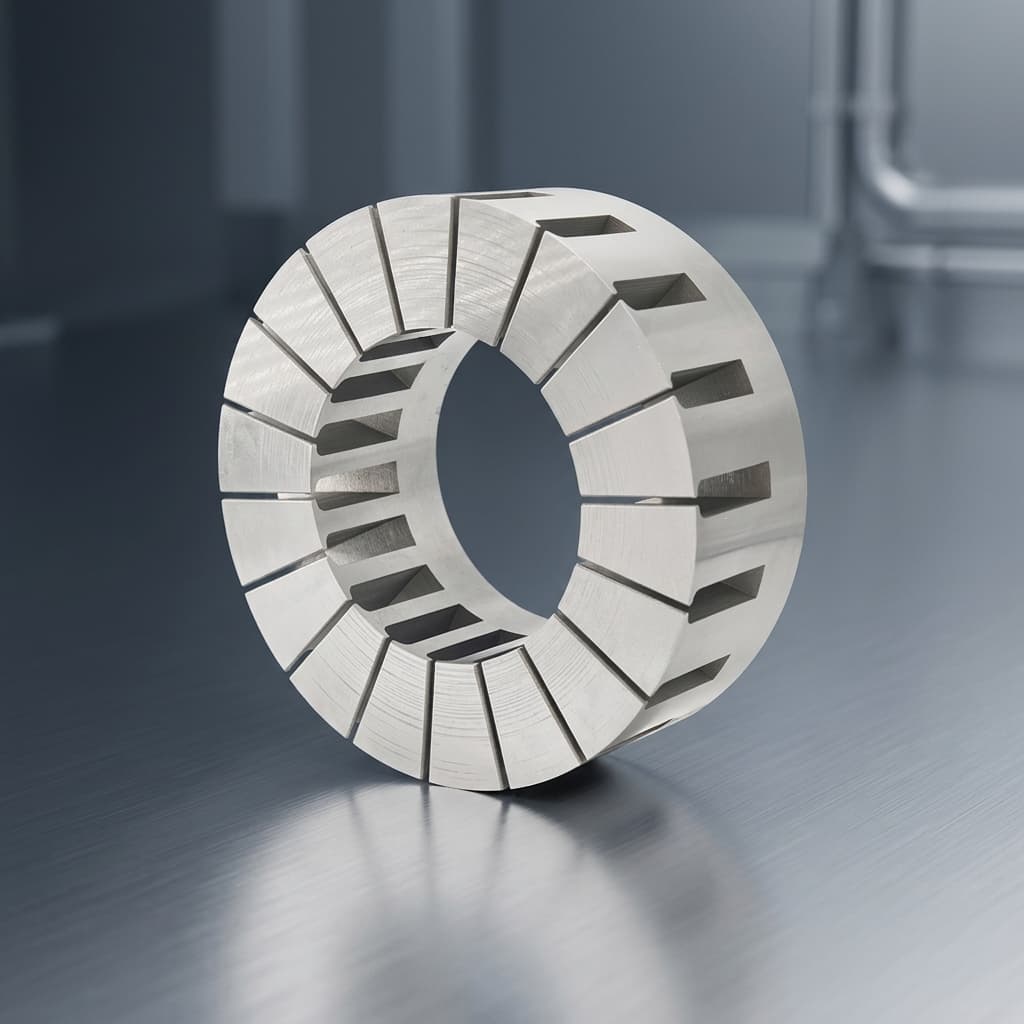
High fidelity render of a compact near-net-shape 3D SMC core
SMC flux concentrator geometry for bridge and local saturation review
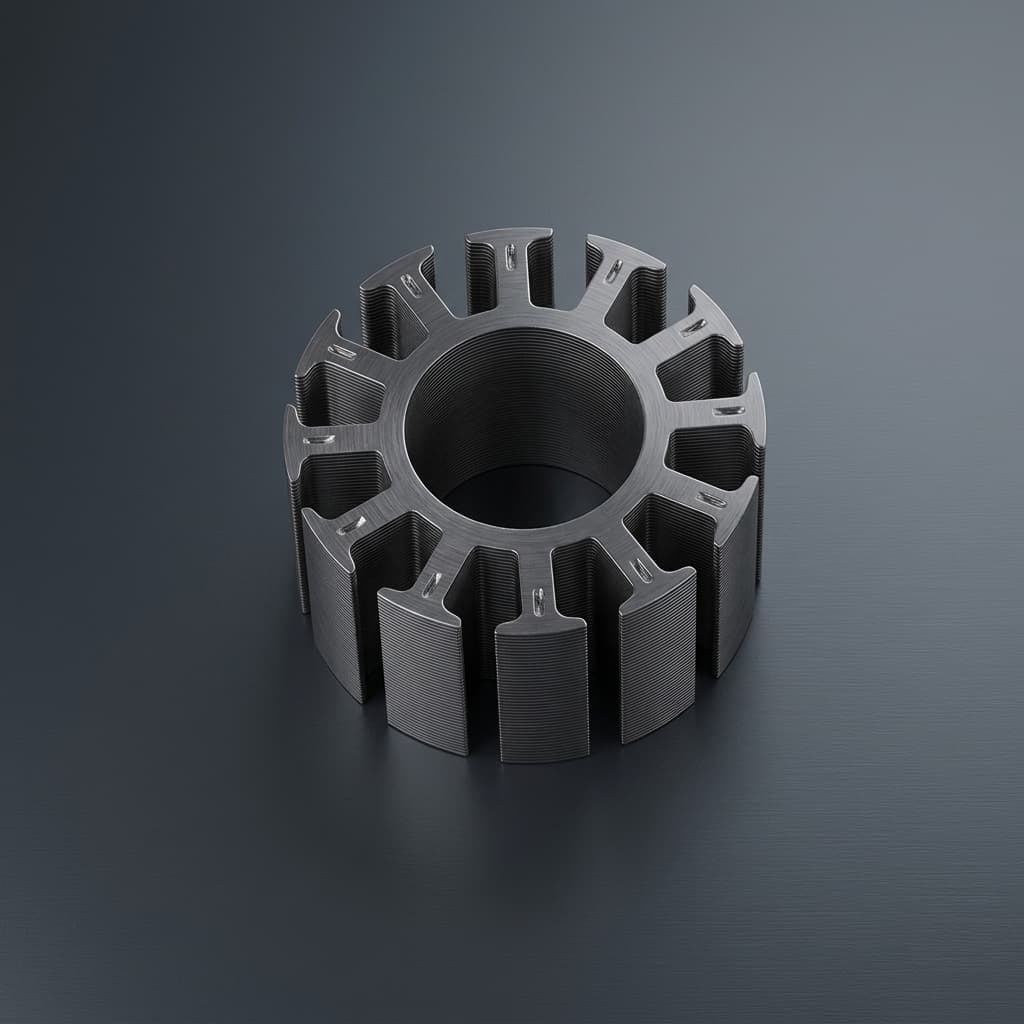
3D magnetic flux SMC stator path for lamination comparison

Buyer FAQ

Can SMC replace silicon steel in every motor?

No. SMC is strongest when 3D flux, compact geometry, segmented manufacturing, or high-frequency loss control justifies the material route.

What does 3D isotropic flux mean for an RFQ?

It means the design expects meaningful magnetic flux in more than one direction, such as radial, axial, and circumferential components. The RFQ should include CAD, simulation context, target B field, frequency spectrum, and acceptance tests so manufacturability and magnetic evidence can be reviewed together.

Can you work with Somaloy 1P, 3P, or 5P requirements?

We can review Somaloy-family or equivalent insulated iron-powder requirements as RFQ routing input. Final material feasibility, availability, density, heat treatment, and magnetic evidence must be confirmed against the buyer operating point and sample test conditions.

What density can be targeted for 3D SMC cores?

A 7.4-7.6 g/cm3 planning target can be discussed where geometry and SMC route allow, but it is not a universal guarantee. The density method, local geometry, compaction route, sample ID, and acceptance report should be defined before pilot approval.

Do you provide B-H curves and core-loss data?

The page supports defining a B-H or core-loss test scope. Useful reports should state flux density, frequency, waveform, temperature, sample geometry, density, heat-treatment route, and revision ID so the numbers can be compared responsibly.

When is a 3D SMC flux concentrator better than a laminated part?

SMC is usually stronger when the flux path bends through complex 3D geometry, the part needs near-net shaping, high-frequency eddy-current control matters, or assembly simplification is valuable. Laminations may still be better for low-frequency high-permeability designs with simple 2D flux paths.

What should be included in a prototype approval package?

A practical package can include FAI, CMM or 3D scan, CTQ table, density or weight baseline, B-H or core-loss test scope, coating or insulation note, corrosion and packing note, sample IDs, and material-route traceability.

Related Resources

  • SMC material data hub
  • Manufacturing & quality controls
  • Technology & Materials
  • Axial Flux Motor Core
  • AFPM SMC Stator
  • SMC Stator Segments
  • Magnetic Loss Validation
  • SMC Core Manufacturing
  • Compaction Tooling DFM
  • Lamination & Winding Services
  • Manufacturing & Quality
  • Contact / RFQ

Inquiry Email

[email protected]

Email app

Attach STEP/DXF/PDF plus frequency, flux density, sample quantity, annual forecast, and destination.

Instant Chat

+8618857971991

Chat on WhatsApp

Direct response from our engineering team.